AI-assisted development
CLAUDE.md vs Skills: Where Claude Code Instructions Belong
Separate persistent repository facts from specialized procedures, with a translation-review example that exposes duplicated and conflicting instructions.
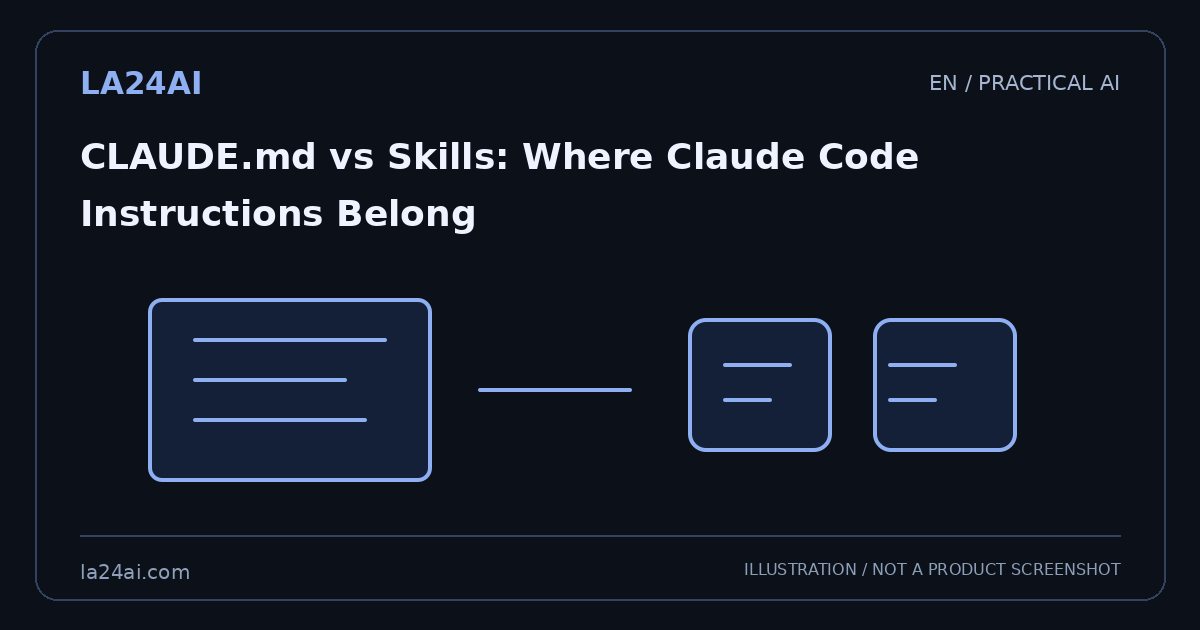
A repeated instruction is not always a global rule
Claude Code documentation distinguishes persistent instructions in CLAUDE.md from procedures provided through Skills when needed. A checklist you keep pasting for one workflow serves a different purpose from a fact required in every session. Organizing those layers does not automatically improve a model’s reasoning.
Consider reviewing a public application’s interface translation. File encoding, the check command and the location of strings are persistent facts. Inspecting abbreviations, plural forms, context and layout is a specialized procedure. Loading every detail at the beginning of unrelated tasks makes the relevant conditions harder to identify.
A two-part brief instead of a growing wall of text
Keep the string directory, verification command and requirement to preserve keys in the persistent instructions. Let the review procedure request a report containing the key, previous text, proposed text, reason and check status. The example below illustrates the division; it is not an executable configuration installed on your device.
Try the procedure on three synthetic strings: Save, Delete all items and a message containing {count}. Reject a fluent rewrite that removes the variable or changes a consequential action. Require a reason tied to the screen’s meaning instead of accepting “sounds more natural” as sufficient evidence.
Persistent facts:
- UI strings live in locales/
- Preserve every translation key and placeholder

Specialized review procedure:
- Compare meaning with screen context
- Report key, original, proposal, reason and check status
- Leave already-correct strings unchanged
A structured procedure does not establish translation accuracy; check preserved placeholders and meaning before accepting a proposal.
Download example text ↓Avoid copying the same rule into every layer
Skills support explicit invocation and use when relevant, with the procedure body loaded when used. Decide where a rule belongs rather than duplicating it everywhere. When a test command changes, there should be an identifiable source to update instead of several conflicting copies.
Keep the output contract in one place and reference it where needed. Distinguish examples from requirements: a demonstration involving a Delete label should not make every later review edit a deletion control. Inspect instructions copied from elsewhere before giving them a persistent role in your workflow.
Successful invocation is not successful evaluation
Check the procedure against a known mistake and a correct case that should remain unchanged. If it rewrites both merely to produce activity, the acceptance criteria need work. Record why a suggestion was rejected and revise the particular instruction that caused it.
Instruction files guide behavior; they do not enforce access permissions. Do not depend only on a sentence such as “never publish” to block a sensitive action. Review tool permissions separately. Features evolve, so check the current documentation before moving a procedure between environments.
When a review procedure grows too broad, use to separate its steps without duplicating the standing instructions.
Sources & further reading
Official documentation checked on 25 October 2026. Examples are constructed illustrations, not account tests or guarantees of feature availability.
Sources support concepts and features; proposed trials are educational examples.
Prepared with AI assistance. Educational examples are not product tests; actual measurements identify their method and scope. Editorial approach ↗