Trace claims to evidence, separate missing information from error, and compare models on the same explicit acceptance rules.
YOUR COLLECTION
Reading list
Saved stories stay in this browser. Return whenever it suits you.
No saved stories yet. Use the + beside a story.
A reproducible comparison using synthetic invoices, exact field acceptance rules, failure labels and cost per accepted file—not marketing features or invented model rankings.
Plan a safe rename of AI evaluation files: detect collisions, recheck destinations and record each operation so partial failures can be recovered.
Ollama: a starting point for local models
Make a local Ollama request, distinguish service errors from answer errors and calculate generation speed without hiding model-loading time.
Hugging Face: read the model card first
Inspect a Hugging Face model card, license, tokenizer and file revision, then keep a reproducibility record before downloading weights or running code.
n8n: map the data before connecting nodes
Build an n8n AI extraction workflow that checks field types and the current item before any external action, with a visible review branch.
Obsidian: turn notes into a small knowledge network
Use Obsidian for AI study notes that preserve a decision, its evidence and meaningful links, then verify attachments survive outside the app.
Compare local and hosted AI using accepted-output cost, waiting time, data flows and hard constraints, with an explicit break-even example.
Read AI benchmark scores with task, dataset, metric and attempt count attached, then check whether the comparison covers your real Arabic or English workload.
Design narrow, testable agent actions and bind approval to the exact recipient and file version; a reviewed draft must not authorize a different send.
What should a model watchlist track?
Track AI model updates with separate announcement, check and artifact-revision records, focusing on license, tokenizer and chat-template changes that affect use.
RAG: watch the evidence that reaches the answer
Diagnose RAG failures with retrieved passages and claim-level evidence, separating missing evidence from generation that ignores it.
Portable knowledge: test your exit before committing
Test whether AI notes and references survive export: attachments, relative links, Arabic text and the difference between reading and restoration.
Define the task, supply the right evidence, specify the output and decide how missing information should be handled.
Extract a reviewable table with raw values, source spans and rejection reasons, then check counts, dates and amounts independently of the AI output.
Read AI papers through task, dataset, baseline and evaluation protocol, distinguishing reported findings from what their experiments actually support.
Review AI code through its diff and behavior: reproduce the original failure, test boundary and Arabic inputs, and inspect side effects before acceptance.
Separate extraction, summarization and writing when their acceptance rules differ, using inspectable intermediate records rather than blindly adding AI steps.
Write testable AI constraints for scope and missing values, resolve conflicting instructions and state which requirement takes priority.
Build AI prompt examples covering ambiguity and rejection, while keeping evaluation cases separate so copying an example is not mistaken for generalization.
A six-case invoice exercise separating syntactic JSON, schema conformance and factual agreement with the source document.
Prepare AI context containing necessary evidence and identifiers, then test whether removing clutter accidentally removes a decisive exception.
Make AI expose missing evidence and separate explicit facts, allowed calculations and unanswerable questions instead of treating confident wording as accuracy.
Verify an AI answer’s citations with a claim-level evidence record that separates direct support, scope restrictions, contradictions and interpretation.
Actual local counts show how Arabic, diacritics, code and emoji differ between two tokenizers, and what a raw-text count leaves out.
Test AI image reading against a known synthetic visual reference: separate extracted text from inference and verify numbers, currency, and table context before accepting an answer.
Review AI rewrites against names, numbers, negation and conditions so smoother wording does not silently broaden a claim or change its meaning.
Choose a smaller model by countable accepted outputs, including escalation and review costs; neither parameter count nor price per token establishes task fit.
Measure local AI latency as loading, input processing and generation, comparing cold and warm requests with controlled output length.
Test long AI context with evidence placed at the start, middle and end, checking the supporting passage rather than equating window size with reading.
Compare AI quantization through runtime memory, compatibility and task errors, separating weight size from context memory and device-dependent speed.
Choosing AI for translation, customer support or document extraction? Use 12 Arabic examples with known answers to catch meaning and number errors before using it at work.
Use explicit weights and hard requirements, then check how the decision changes when your assumptions change.
An eight-case release gate that separates improvements from regressions and blocks a model switch that breaks a critical field.
Test temperature with repeated fixed requests, measuring factual errors and useful variation separately from other settings and model changes.
Choose an AI agent or fixed workflow by the decisions that cannot be predeclared, their consequences and the cost of reviewing model-selected branches.
Define an AI tool’s input contract, side effects and errors, then test selection and invalid arguments without trusting the model to enforce permissions.
A practical allow/deny matrix for file-reading and draft-writing agents, with explicit negative tests before connecting real data.
Hand off AI work as a versioned state with evidence, unresolved fields and permitted next actions, without converting guesses into facts or new authority.
A task-specific attempt, time and side-effect budget with explicit state verification before retrying a write.
Give AI memory provenance, scope and expiry, testing conflicts and deletion instead of treating every stored statement as a permanent fact.
Test prompt injection in documents read by AI, separating retrieved text from tool authority and checking both the output and attempted actions.
Make approval previews identify the destination, content and diff, rejecting changed artifacts and repeated operations rather than trusting a generic approval flag.
Choose a first AI automation by setup, review and recovery costs, using a small reference result to prove useful savings without concealing errors.
Choose schedules, events or polling by discovery delay and overlap behavior, keeping a source-check timestamp separate from completed AI processing.
Prevent repeated AI-automation side effects with stable event identifiers and retained outcomes, including the failure window between execution and acknowledgement.
Make dry runs produce the same execution plan, detect destination conflicts and avoid every mutating action, including preparation-stage uploads or messages.
Design AI retries around authentication, rate and allocation errors, honoring Retry-After without repeating an action whose outcome is uncertain.
Calculate AI-automation payback after review, failure repair and maintenance, using accepted outcomes and realistic usage scenarios rather than generation time alone.
Log AI automation as distinct start, validation and persistence events with run and input revisions, without storing secrets or entire documents.
Receive webhooks for AI workflows with raw-body signature checks, replay handling and durable acknowledgement, keeping receipt distinct from processing completion.
Diagnose automation schedules with named time zones and separate scheduled, started and completed times, defining seasonal and missed-run policies explicitly.
Turn uncertain AI outputs into a review queue with specific reasons, evidence and next actions, protecting decisions against concurrent or obsolete edits.
Diagnose a one-column CSV, preserve quoted separators and identifiers, and validate import types before an AI tool interprets the table.
Separate wrong UTF-8 decoding from lost characters, then check BOM handling and mixed-script text before judging Arabic OCR or AI analysis.
Preserve raw dates and source conventions in AI extraction, distinguishing calendar days, event times and publication or check timestamps.
Define field meaning, units and missingness before cleaning AI outputs, recording transformations and explicit rejections rather than hiding guesses.
Validate AI-generated JSON beyond formatting: reject duplicate keys, check types and missing values, and distinguish limited repair from factual correction.
Review AI tables with whole-table rules, consequential field matching and documented sampling; matching totals do not establish correct records.
A complete Arabic OCR review exercise using reference fields, preserved IDs, arithmetic checks, reading-order evidence and an explicit acceptance decision.
A black rectangle does not prove information was removed from a PDF.
Define identity before deduplicating AI data, compare false merges with missed matches, and retain sources and legitimate historical versions.
Preserve why AI-extracted values are missing; do not turn null into zero or inference, and report denominators and missingness policy.
Understand when an AI API error calls for authentication fixes, backoff, job polling or result verification—without blindly repeating a billable operation.
Use read-only Windows checks to tell hostname resolution failures apart from blocked HTTPS connections, API authentication issues and local-model outages.
Distinguish an encrypted connection from a trustworthy service. Check the real login destination and file-handling terms before sharing documents.
Choose rendering time by freshness and privacy; a static AI page can show changing data with an honest fallback when later requests fail.
A good-looking screenshot is not enough. Test long prompts, visible results, copy actions, Arabic RTL and text zoom before publishing.
A keyboard-only journey through an AI utility, from entering a request to copying its result, including visible focus and useful errors.
Keep AI images legible without forcing mobile visitors to download oversized originals. Compare the browser-selected file, fine details and above-the-fold performance.
Distinguish stale HTML, cached JavaScript and outdated API data before purging caches or claiming a successful release.
Update one library with a reproducible lockfile, task-level regression and verified rollback instead of treating a successful build as proof of compatibility.
Make AI utility errors identify the failed input or stage and the next action, with trace IDs that do not expose credentials or document content.
Compare a summarizing or writing extension’s stated job with its requested permissions, including single-tab and persistent site access.
Test local-processing claims with synthetic files, distinguishing interface loading from content transmission, persistence and optional remote AI paths.
Review the final image you plan to edit or upload: location metadata, background details and the image service’s storage policy.
Preview the real destination before signing up or installing an AI tool from a QR code, without exposing passwords or access tokens.
Separate account recovery from API credentials, avoid plaintext exports in AI uploads, and verify a password-manager migration without exposing secrets.
Understand what passkeys protect, plan recovery, and distinguish account login from AI connector permissions, sessions and API keys.
Troubleshoot browser AI voice input by separating operating-system access, site permission, input selection and transcription quality.
Separate browser history from AI account records, uploaded files and provider retention. Use a clean session to diagnose access problems without exposing real documents.
Build a short AI tutorial around a verifiable outcome, reserving time for the problem, action and evidence instead of cramming unrelated tips.
Record AI tutorials with reproducible input and visible steps, distinguishing actual runs from illustrations or documentation-based descriptions.
Review Arabic captions against actual speech, checking negation, numbers, names, bidirectional rendering and SRT timing in the final player.
Write image alternatives around their role in an AI article, preserving chart meaning and accessible data without keyword stuffing or decorative noise.
Make an AI article title and cover match its delivered result, with explicit limits and evidence instead of curiosity that has no answer.
Edit AI-produced Arabic with concrete before-and-after examples, preserving actors, numbers, negation and uncertainty while removing literal-translation overhead.
Tie technical claims to evidence and source revision, separating official information, analysis and test results before editing with AI assistance.
Design source-bounded recall questions, delay answer reveal, and separate an AI tutor’s feedback from evidence of what you can explain independently.
Record the mistaken reasoning rule and test its correction on a contrasting example, rather than asking AI to collect correct answers without diagnosis.
A practical way to separate what vendor documentation actually establishes from claims requiring independent testing and a dated methodology.
Use binary search to turn an AI coding explanation into predictions, boundary tests and a record of assumptions instead of copying an answer.
Design AI experiments around bounded questions, shared inputs and declared acceptance rules, measuring time to verified output rather than generation alone.
Build definition cards with counterexamples and practical consequences; distinguish tokens, context limits and different kinds of AI caching.
VS Code: start with a small folder before adding extensions
Review AI coding changes in a scoped VS Code workspace, distinguishing project trust, extension access and the actual runtime environment.
Git: save a checkpoint you will understand next week
Commit AI edits only after reviewing staged files and excluding secrets, keeping local history distinct from backup and deployment.
Python: begin a useful script with a test file
Begin Python automation with an inspectable read-only report, adding input and failure boundaries before AI-written code modifies files.
SQLite: when does a project outgrow one table file?
Store AI workflow results in SQLite with constraints, relationships and transactions, keeping model text out of executable SQL and avoiding row-count myths.
LibreOffice Calc: organize a data exercise on your desktop
Import AI-extracted tables into Calc while preserving identifiers and dates, verifying CSV export values instead of trusting visual formatting.
Zotero: make references retrievable when you write
Use Zotero to connect AI research references with claims and locations, verifying DOI and version rather than trusting a model-generated citation.
Calculate Arabic character error rate on a worked example, then check critical numbers, normalization and document layout separately.
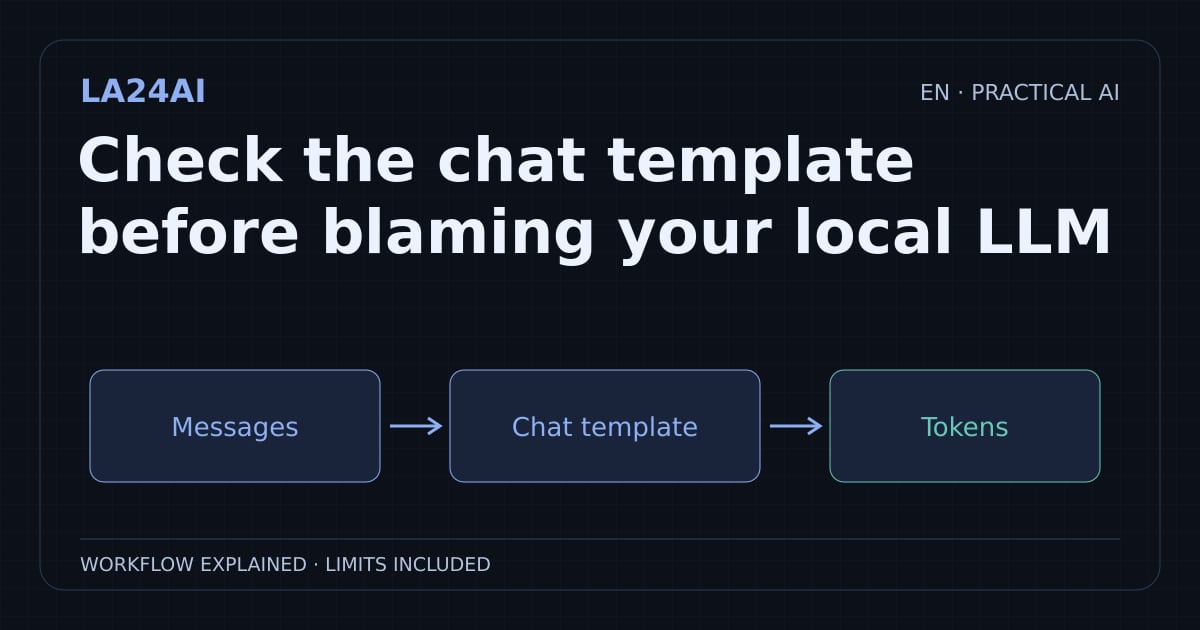
Check the chat template before blaming your local LLM
Inspect Transformers chat formatting, generation prompts and special tokens before treating a local model’s weak answer as a capability problem.
Work through overall and language-balanced success rates, with sample counts and acceptance gates that expose failures hidden by an aggregate.
A worked hypothetical 10-request cost model shows cache-write overhead, discounted reads, break-even behavior, and how cache misses can reverse the result.
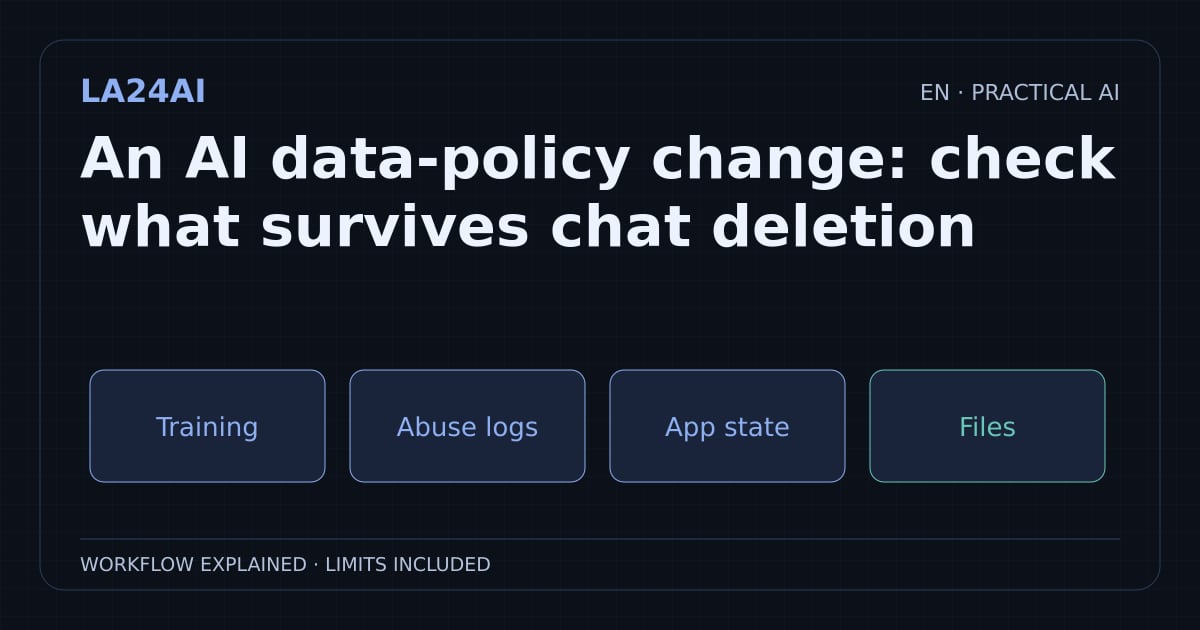
An AI data-policy change: check what survives chat deletion
Separate training use, abuse logs, application state, files and third-party tools when reading an AI provider’s retention-policy update.
Resolve a worked retrieval conflict using effective dates, scope and revisions instead of choosing the most recently fetched document.
Run Whisper for Arabic on Windows: Transcribe, Check WER and Review Critical Errors
A reader-run Windows workflow for local Arabic speech transcription with Whisper, FFmpeg, reference transcripts and explicit checks for names, numbers and dates.
ComfyUI: build an image workflow you can reproduce and inspect
Start with a small official template, record the model, seed and resolution, and save the workflow alongside the image instead of keeping an unrepeatable result.
Audacity before AI transcription: does noise reduction preserve the words?
Prepare a copy for transcription, compare it with the original, and listen to the removed signal so cleaning noise does not erase Arabic speech.
llama.cpp locally: run a model without exposing it to the whole network
Understand GGUF and llama-server, start on loopback, and inspect memory and context behavior before connecting another application.
Mistral OCR: extract document structure, then check the numbers
Separate page recognition from field extraction, and use a synthetic PDF to inspect columns, Arabic numerals and document boundaries before sending a real file.
Sentence Transformers: test retrieval before adding generated answers
Build a known question-and-passage set, measure whether the correct passage appears in the top results, and separate retrieval, reranking and answer generation.
A reproducible 100-question example compares input tokens, indexing, missing evidence, and review cost, showing exactly when the cheaper approach changes.
Build a declared listening test for names, numbers, diacritics and dialect, while keeping intelligibility separate from preference.
Turn a long prompt into a shot plan that preserves identity, direction and objects, then inspect continuity without assuming a seed guarantees matching scenes.
Compare cell extraction with table interpretation using a bilingual sample, confusing numerals and missing rows, tracing every value before counting success.
Review the diff, interface contract and failure cases against a reference so a narrow AI-generated fix does not silently change permissions or outputs.
Distinguish vector space from vector length, retain the index model identity, and test a versioned migration instead of mixing incompatible representations.
Use NFC for equivalent representations, keep search keys separate from original text, and inspect diacritics, hamza and numerals before deleting differences.
Give evidence a document ID, revision and passage boundaries, then reject citations that do not support the adjacent claim even when their links work.
Run a synthetic retrieved-document experiment, grade both task completion and instruction-boundary failures, and keep tool permissions separate from untrusted text.
A synthetic invoice exercise shows why valid JSON is not enough: represent missing fields as null, preserve identifiers, and reconcile arithmetic with source evidence.
Check overlapping cues, reading load and mixed numerals, preserving sentence meaning while splitting text instead of pasting an AI transcript into a video.
Separate development questions from final evaluation and inspect paraphrases and shared document families before treating a higher score as real improvement.
An open-model announcement: what to inspect in its license
Distinguish downloadable weights from usage conditions and tie the model identity to a license revision before interpreting an announcement.
An AI model shutdown: turn the announcement into a migration plan
Separate announcement and shutdown dates, locate real dependencies, and test replacement input and output contracts rather than changing only the model name.
A larger context window: is there room for the answer you need?
Budget messages, tool overhead and reserved output, distinguishing a capacity limit from useful retrieval quality instead of treating an announcement number as proof.
Before downloading a new model: inspect publisher, files and accompanying code
Track weight provenance, revision and fingerprints, separating storage-format safety from trust in code a loader may request.
An AI tool price change? calculate cost per accepted result
Translate credits, attempts and subscriptions into comparable costs, separating an advertised rate from accepted exports and account limitations.
An AI feature was announced but is missing: how to check availability
Distinguish an announcement from actual access, checking account, platform, version and eligibility before treating a missing feature as a defect.
Build an image brief around placement, lighting and text space, with an editable example and concrete output checks.
A local redactor can find common patterns. This worked example shows a successful replacement and an obfuscated address it misses.
Separate file syntax from readability: inspect cue duration, overlaps, line length and characters per second before exporting.
A worked example separating parseable JSON from output that respects required fields and types, using a clearly bounded local validator.
A transparent worked budget separates input, output, retries and rejected results instead of stopping at a price per million tokens.
Build cases that expose unsupported answers, separating missing evidence from retrieval failure with a local JSONL evaluation set.
Read time to first token, completion time and p95 correctly, with a synthetic sample showing the effect of slow requests.
A practical protocol for hiding option names, alternating output order and recording errors before calculating a final score.
AnythingLLM document chat: trace the local-processing boundary
Trace model, embedding and storage choices before adding sensitive files, and distinguish workspace removal from document deletion.
LM Studio offline: verify the downloads before disconnecting
Check models and runtimes, distinguish local chat from downloads and updates, and verify offline behavior without broad privacy claims.
Piper Arabic TTS: inspect the voice, pronunciation and license
Start with the voice file and configuration, then review names, numbers and negation while keeping engine and voice licensing separate.
Gemini search grounding: connect each claim to its evidence
Review grounding references and supported text spans without assuming every answer is verified merely because search is enabled.
After a model launch, read the system card for the limits
Inspect evaluation scope, settings and untested conditions, separating safety mitigations from evidence for your own task.
AI service outage—or a problem with your request?
Distinguish outages from usage limits and authorization failures, recording evidence before repeated retries.
Same model name, different files: track the revision
Track revision, tokenizer and configuration changes, distinguishing edited documentation from changed weights before comparing results.
Content Credentials: what do they establish about an AI image?
Read provenance and integrity signals without confusing them with factual truth, rights clearance or proof that an image was never edited.
Understand the separate controls for personalization, history, training and retention before choosing a temporary chat for a sensitive or unbiased task.
ChatGPT Projects: Build a Source-Controlled Workflow, Not a File Pile
Set up a repeatable ChatGPT Project using three fictional files, an approval manifest, testable project instructions and a conflicting-date acceptance test.
Use a three-month synthetic chart to test PDF visual access, unit extraction, source attribution and two independent percentage calculations.
CLAUDE.md vs Skills: Where Claude Code Instructions Belong
Separate persistent repository facts from specialized procedures, with a translation-review example that exposes duplicated and conflicting instructions.
A practical permission-review workflow for Claude Code: define each command’s effects, test least privilege, and never equate a small UI fix with permission to deploy or inspect secrets.
NotebookLM / Gemini Notebook: Verify What Each Citation Supports
Turn notebook answers into a claim-by-claim evidence check. Open citations in context instead of treating a reference number as proof of an entire paragraph.
A practical client-bundle and network checklist, a bounded backend architecture and rejection tests without publishing real credentials.
Use a schema for structure, then test arithmetic, units and duplicates separately. A synthetic invoice shows why parseable JSON can still be unusable.
Build an inspectable Arabic poster by separating the artwork from exact wording, then check letters, digits and reading order before publishing.
Veo First and Last Frames: Plan the Shot Before the Prompt
Define an inspectable video transition with consistent endpoints, a separate reference role and a motion brief that describes what must happen between them.